If you’re planning to build a deck in Colorado Springs, one of the first big decisions you’ll face is this:
Should you choose wood or composite decking?
Both materials are popular. Both look great. Both can create an amazing outdoor space for relaxing, grilling, or watching the kids play. But in Colorado Springs, this decision isn’t just about cost and maintenance.
It may also be about wildfire regulations and permitting.
Let’s break everything down so you can confidently choose the right decking material for your home, your budget, and your location.
First Things First: Check If You’re in a Wildland-Urban Interface (WUI) Zone
Before comparing wood and composite, you need to answer one important question:
Are you in Colorado’s Wildland-Urban Interface (WUI)?
Many neighborhoods in Colorado Springs fall within wildfire-prone areas. If your home is in a designated WUI zone, decking materials may be restricted.
You can learn about Colorado’s WUI classifications here.
To check your specific property, use the interactive WUI hazard map. Simply enter your address and review your wildfire hazard rating.
What Do WUI Ratings Mean for Your Deck?
If your home falls within a WUI-designated zone, material choices may be regulated.
Here’s the key rule:
- Class C fire rating or better → Wood decking is allowed
- Below Class C → Wood decking is typically not permitted
- You must use materials approved by the fire department
In higher-risk zones, decking materials must meet specific fire-resistance standards. This often means:
- Fire-rated composite or fire-rated wood decking
- Approved structural framing methods
- Ember-resistant construction details
This is not optional and will be reviewed during the permitting process.
The WUI Permitting Process in Colorado Springs
If your property is in a WUI area, here’s what to expect:
- Southern Mesa will submit an application through the Pikes Peak Regional Building Department.
- Fire Department Review – If you’re in a WUI zone, your plans will be routed to the fire department for approval.
They evaluate:
- Decking & Railing material
- Fire rating
- Structural exposure
- Defensible space compliance
- Construction – Once approved & permit issued, construction can begin.
- Final Inspection – includes:
- The fire department will perform a final inspection
- Materials and mitigation measures are verified
- Approval is issued
**This step is critical. If materials don’t meet requirements, corrections will be required before sign-off.
Ignition-Resistant Construction: What That Looks Like
An ignition-resistant deck system typically includes:
- Fire-rated or ignition-resistant decking boards
- Non-combustible zone near foundation (no mulch)
- Reduced vegetation within specified clearances
- Proper attachment to ignition-resistant siding systems
It’s a systems approach — not just a product choice.
What Is Wood Decking?
Wood decking is the traditional choice and includes:
- Pressure-treated pine (most affordable)
- Cedar
- Redwood
- Exotic hardwoods
Wood offers a warm, natural appearance that many homeowners love. It can be stained nearly any color and customized over time.
It’s also typically the lowest upfront cost option — assuming your zoning allows it.
What Is Composite Decking?
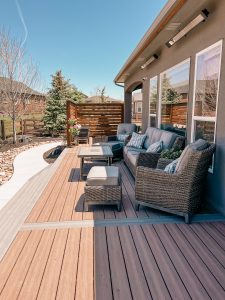
Composite decking is engineered from wood fibers and recycled plastics. Brands like Trex and TimberTech create boards designed to look like real wood but resist:
- Rot
- Warping
- Insects
- Splintering
Composite costs more initially but requires significantly less maintenance.
In many WUI zones, fire-rated composite decking becomes the preferred or required option.
Wood vs. Composite Decking: Cost Comparison in Colorado Springs
Here’s what homeowners typically see:
Wood Decking
-
- $80–$120 per sq ft installed (*non-fire rated)
- Staining/sealing every 2–3 years
- Higher lifetime maintenance cost
- Fire rated wood decking will be more comparable to the below composite pricing
Composite Decking
- $110–$180 per sq ft installed
- Minimal maintenance
- Often available in fire-rated options
Over 20–25 years, maintenance costs often narrow the gap between the two. Composite may cost more upfront, but in WUI zones, it does simplify compliance. If you’re planning a larger outdoor transformation — such as adding a patio cover or coordinating with a future ADU — material selection should align with your long-term remodel timeline. We discuss planning strategies like this in several guides on our education page.
Maintenance & Durability in Colorado’s Climate
Colorado decks face:
- Intense UV exposure
- Freeze-thaw cycles
- Snow loads
- Hail
- Dry air
Non-Fire Rated Wood:
- Annual cleaning
- Stain/seal every 2–3 years
- Occasional sanding
- Board replacement
- 10–15 years average lifespan – longer with diligent maintenance
- More susceptible to moisture and sun damage
Composite Requires:
- Clean 1–2 times per year
- No staining, sealing, sanding
- 25–50 year lifespan depending on product – often backed by 25-year warranties
- Resistant to rot and insects
WUI Deck Planning Checklist
Before choosing materials:
☐ Check your address on the WUI map
☐ Download and review the Ignition Resistant Design Manual
☐ Confirm whether Appendix K applies to your project
☐ Verify decking material fire rating documentation
☐ Plan for ember-resistant under-deck protection
☐ Budget for potential upgrades
☐ Schedule permit review before purchasing materials
Skipping these steps can lead to costly redesigns.
Pros and Cons of Wood vs. Composite in Colorado Springs
| Category | Wood Decking | Composite Decking |
| Upfront Cost | Lower upfront cost | Higher upfront investment |
| Maintenance | Requires ongoing maintenance (staining, sealing) | Minimal maintenance required |
| Lifespan | Shorter lifespan (10–15 years typical) | Longer lifespan (25–50 years) |
| Appearance | Natural beauty with real wood grain | Consistent/uniform appearance unless upgrading |
| Customization | Can be stained or refinished over time | Cannot be changed |
| Durability | Can splinter, crack, or warp over time | Resistant to rot, insects, and warping |
| Repairs | Easier to replace individual boards | Higher cost to replace damaged boards |
| Heat Retention | Stays cooler in direct sun | Can get warm in direct sun unless upgrading |
| Fire/WUI Considerations | May be restricted or require treatment in WUI zones | Many ignition-resistant options available |
Final Thoughts: The Right Deck Is the One That’s Compliant and Built to Last
In Colorado Springs, wood vs. composite is not just a style decision.
It’s a compliance decision.
Before committing to materials:
- Verify zoning
- Review the Ignition Resistant Design Manual
- Understand Appendix K requirements
- Plan for inspection
A deck should enhance your home — not create permit problems.
If you’d like help navigating zoning, permitting, and material selection in Colorado Springs, Southern Mesa can guide you from planning through final inspection.
Frequently Asked Questions
Is every Colorado Springs home in a WUI zone?
No. Use the ArcGIS map to verify your address.
Does being in the WUI automatically mean I can’t use wood?
Not automatically. It means your materials must meet ignition-resistant standards and pass fire code review. Certain species of wood does meet this standard (e.g. teak, Ipe)
Do I need fire department approval for a deck?
If you’re in a WUI-designated area, yes — your plans will require fire code review under Appendix K.
What happens if I build without meeting WUI requirements?
If your deck does not meet WUI requirements, it may fail inspection and require modifications or removal of non-compliant materials. Building without a permit can also result in fines, and in many cases, homeowners are required to tear down and rebuild the structure to meet code.
Is composite safer in wildfire areas?
Many composite products carry ignition-resistant or fire-rated classifications, which often makes compliance easier. However approved wood species are just as “safe” as their composite counterparts.